Trade Show Marketing for Design Suppliers: What Actually Works at Decorex, Focus & Maison
By Grant Pierrus, founder of Pierrus Agency
Published 10 February 2026
Most trade show marketing advice is generic. Here's what actually separates the suppliers designers specify from the ones they forget.
Most trade show marketing advice is written by people who've never worked a stand. It's all "create buzz" and "maximise engagement" without explaining what that actually means when you're a lighting brand trying to get interior designers to remember you.
I've spent 15 years at design trade shows - not walking the aisles, but hosting panel discussions at Decorex, London Design Week, Focus, and Maison et Objet. I've watched hundreds of suppliers try to connect with designers. Some get it right. Most waste their exhibition budget on beautiful stands that generate nothing.
Here's what separates the suppliers designers actually specify from the ones they forget by the time they reach the coffee queue.
Why Design Trade Shows Still Matter
Digital has changed everything except this: specification decisions are relationship decisions. An interior designer choosing between three fabric suppliers with similar quality and price will pick the one they've met, whose name they remember, whose stand they visited last September.
Trade shows compress months of relationship-building into three days. One meaningful conversation at Decorex can lead to specification on five projects over the next two years. That's not something Instagram delivers.
But here's what most suppliers miss: the show itself isn't where you win. The show is where relationships that started before and continue after get accelerated.
The suppliers who get specified aren't necessarily the ones with the biggest stands or the best products. They're the ones designers remember. And memory is built through repeated, meaningful contact - the kind trade shows make possible.
Before the Show: Where 70% of Success Happens
Choose the Right Show
Not all design shows serve the same audience. I've seen suppliers waste significant budgets exhibiting at shows where their target designers simply don't go.
Decorex - The serious specification show. Designers come to source. If you're targeting UK residential interior designers, this is your priority. It's where the conversations turn into projects.
Focus - Contract and hospitality focused. Stronger for suppliers targeting commercial projects, hotel groups, and large-scale residential developers. Less foot traffic than Decorex, but more focused on serious specifiers.
London Design Week - Broader audience, more consumer crossover. Good for brand awareness and press coverage, less reliable for direct specification leads. Worth considering if you're building brand recognition, but don't expect your stand to fill your pipeline.
Maison et Objet - International reach, European design community. Worth it if you're targeting beyond the UK or want serious press attention. The scale is different - plan accordingly.
Pick one or two shows and do them properly rather than spreading thin across five. Better to be memorable at one show than forgettable at three.
Pre-Show Outreach That Works
The designers you want to meet are already planning their show schedule weeks before. They're deciding which stands to visit before they arrive. Your job is to be on that list.
What works:
Direct email to designers you've worked with or want to work with. Not a mass mailout - a personal note: "We're at Stand G47. I'd love to show you the new collection - can I book you a 15-minute slot?" Designers appreciate the efficiency. They can plan their time rather than hoping to stumble across something good.
Hosting something worth attending: a designer breakfast, a private preview, a conversation with someone interesting. At Decorex last year, the stands that drew crowds were the ones offering something beyond product - a reason to stop, sit, listen.
Getting included in VIP tour routes. Contact the show organisers early; these spots fill up fast. Being on a VIP tour puts you in front of senior designers who've already been vetted as serious specifiers.
What doesn't work:
Generic "visit us at stand X" social posts that disappear into the feed. Hoping people will wander by. Relying on the show guide alone. These are what everyone does. They don't differentiate you.
The Press Preview Opportunity
Most shows run a press preview the day before public opening. Editors and journalists walk the show with fresh eyes and empty notebooks. If you have something genuinely new - not a minor colourway update - this is when to show it.
Contact the show's PR team two months before. Have professional photography ready. Have a story, not just a product. "We've launched a new fabric" is not a story. "We've developed a performance fabric that's been specified for three Soho House properties" is a story. If you're new to pitching editors, our guide to interior design PR covers the essentials.
The press preview is also when buyers from major retailers often walk the show. They're looking for what's new, what's different, what they haven't seen before.
During the Show: Making Contact Count
Stand Design That Attracts the Right People
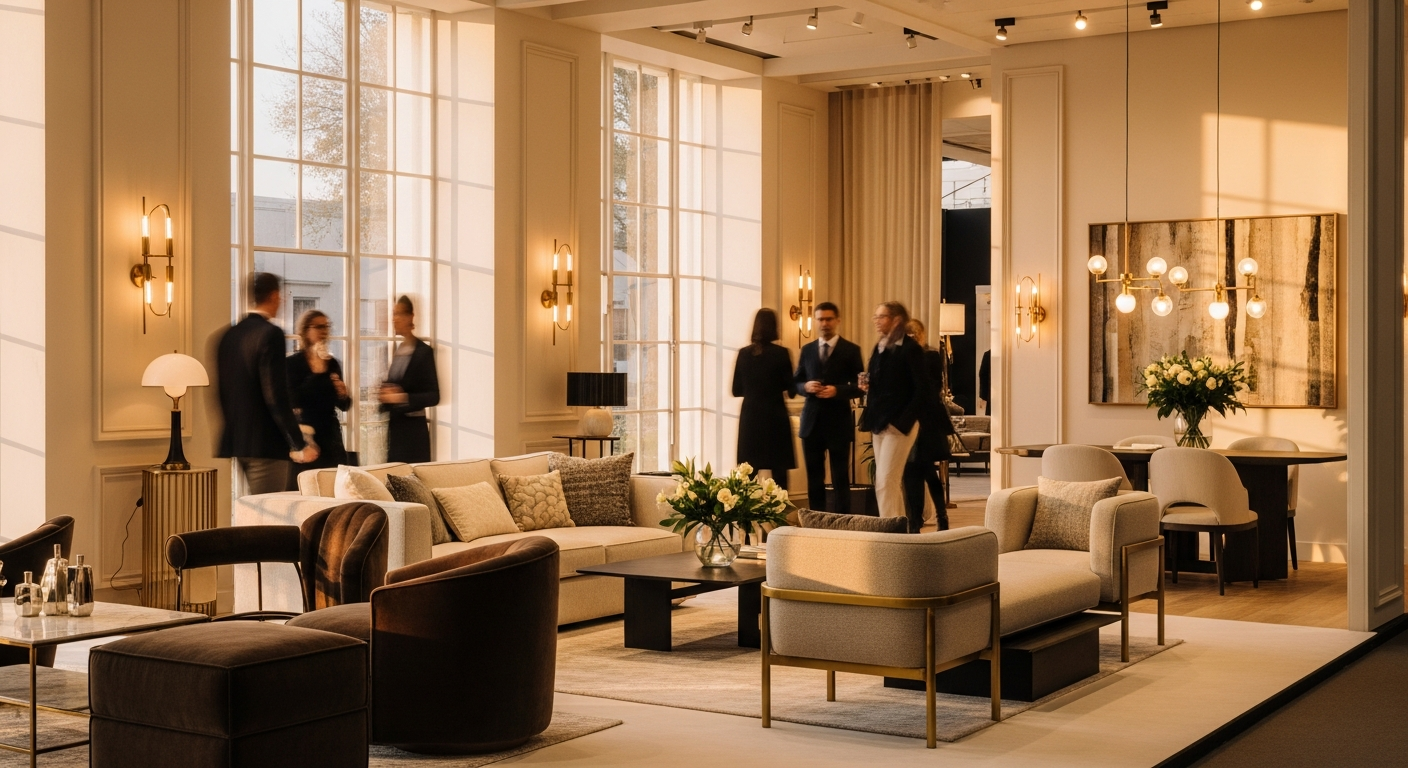
Your stand has one job: start conversations with the people you want to meet.
That means:
Product visible and touchable - Designers want to feel materials, see scale, understand quality. Samples behind glass defeat the purpose. If they can't touch it, they can't imagine specifying it.
Clear proposition - Someone walking past should know what you do in three seconds. "British-made contract upholstery" is better than an artistic installation that needs explaining. You have perhaps two seconds of attention as someone walks past. Don't make them guess. For UK suppliers, the trade advantages you have in international markets make this positioning especially powerful.
Space to talk - A stand rammed with product leaves no room for the conversations that matter. Build in meeting space. Somewhere to sit. Somewhere private enough to discuss an actual project.
I've seen beautiful, expensive stands that generated no leads because there was nowhere to sit down and talk properly. And I've seen modest stands that were always busy because they felt welcoming and the team was engaged.
The other thing: staff your stand with people who can have actual conversations about specification. Not just people who can hand out catalogues. If you're also marketing to architects, the same principle applies - product knowledge and genuine helpfulness beat slick sales pitches.
Conversations That Lead to Specification
The goal isn't collecting business cards. It's understanding what designers are working on and whether you can help.
Ask:
- "What are you sourcing for at the moment?"
- "What's your next big project?"
- "Have you worked with [your product category] before?"
Listen more than you pitch. The designer who tells you about their hotel project in Edinburgh has just given you the opening for a follow-up that actually means something.
The best stand conversations I've observed aren't pitches. They're consultations. The supplier asks questions, understands the project, suggests specific products, offers to send samples. The designer leaves feeling helped, not sold to.
Capturing Leads Properly
A pile of business cards in a drawer is worthless. You need enough context to follow up meaningfully.
At minimum, note:
- What they're working on
- What interested them
- What you promised to send
- Any timing (when the project specifies, when they're next in London)
Many suppliers use lead capture apps. These work, but only if you add the context that makes follow-up personal rather than generic. A badge scan without notes is just an email address you'll never use properly.
The Speaking Opportunity
Panels and talks at trade shows offer visibility that stand presence alone can't match. If you can get a speaking slot - or host a conversation - you position yourself as an authority, not just a vendor.
How to get it: Contact the show organisers six months before. Propose something specific and valuable - not a product pitch dressed as content. Offer to bring in interesting voices: designers you've worked with, architects who've specified your products, someone with a perspective worth hearing.
Is it worth it? Depends on your goals. For brand building and credibility, yes. For direct lead generation, less clear. But the designers who see you on stage remember you differently from the ones who just passed your stand.
After the Show: Where Most Suppliers Fail
The 48 hours after a show close are when most of your competitors do nothing. They're tired. They'll "get to it next week." Next week becomes next month becomes never.
This is where you win.
The Follow-Up That Works
Within two days:
- Email everyone you had a meaningful conversation with
- Reference something specific from your conversation
- Deliver whatever you promised (samples, catalogue, pricing)
- Suggest a next step (call, studio visit, sample delivery)
Good follow-up:
"Great to meet you at Decorex. You mentioned the hotel project in Edinburgh specifying in Q1 - I've attached the contract fabric options we discussed. Happy to send samples to your studio. When works for a call?"
Useless follow-up:
"Thanks for visiting our stand! Please see our latest catalogue attached."
The difference is specificity. The first email shows you listened. The second shows you're batch-processing.
Content From the Show Floor
Trade shows generate content you can use for months: photos of your stand, images of designers engaging with your products, behind-the-scenes setup, panel discussions, press mentions.
Capture it while you're there. Use it afterward. A LinkedIn post three weeks later with "Reflecting on conversations from Decorex..." keeps the relationship warm and positions you as active in the industry.
Building the Long Game
One show won't transform your business. But showing up consistently, following up properly, and building relationships year after year compounds. The designer who visited your stand in 2024, received a helpful sample in 2025, and saw you again at Decorex in 2026 is the one who specifies you in 2027. That's how this works. Trade show marketing is a long game.
Measuring Trade Show ROI
The honest answer: trade show ROI is hard to measure directly because specification cycles are long. The designer you met in September might specify you in March on a project that completes in December.
What you can track:
- Conversations logged (with context)
- Sample requests generated
- Follow-up meetings booked
- Pipeline movement from show contacts over 6–12 months
- Projects where you can trace back to a trade show introduction
What you shouldn't expect:
- Immediate orders
- Clear attribution within 30 days
- A simple "the show paid for itself" calculation
Trade shows are relationship infrastructure. They're part of how you become a known, trusted supplier - which is how you get specified. That's hard to put in a spreadsheet, but it's real.
The better question than "what was the ROI of Decorex?" is "are we building the relationships that lead to specification?" If yes, the shows are working.
Is Exhibiting at Trade Shows Worth It?
It depends on what you're comparing it to. If the alternative is relying on cold outreach and hoping designers find your website, then yes - trade shows offer something those channels can't: face-to-face relationship building with people who influence specification decisions.
If you're a supplier targeting interior designers or architects, the question isn't really whether to do trade shows. It's which shows, how often, and how well.
The suppliers who get value from trade shows are the ones who treat them as part of a relationship strategy, not a standalone event. They prepare properly, they're present and engaged during the show, and they follow up like professionals. The suppliers who waste their money are the ones who book a stand, show up, and hope for the best. Trade shows work best when they're part of a digital-first marketing strategy - where digital visibility gets you discovered, and the show closes the relationship.
The Bottom Line
Trade show success for design suppliers comes down to three things:
- Prepare properly - Pre-show outreach, press preview, VIP tour inclusion, clear goals
- Have real conversations - Listen, understand projects, make notes, be helpful
- Follow up fast - Within 48 hours, with context, with a next step
Do those three things consistently, show after show, and you'll build the kind of trade relationships that fill your specification pipeline for years.
Explore our Marketing for design trade suppliers services, or start a conversation.